
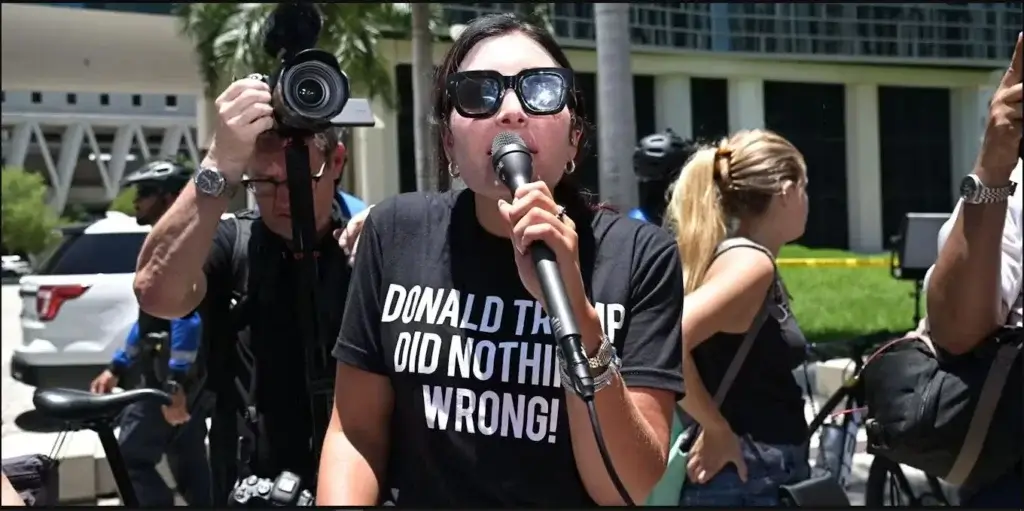
Laura Loomer Influence ascent from far-right provocateur to a figure with tangible sway inside Donald Trump’s second White House has prompted a flurry of media comparisons to Senator Joseph McCarthy. While the Atlantic rightly notes the echoes of McCarthy’s loyalty purges, limiting the frame to a 1950s parallel misses the global and systemic dimensions of what Loomer represents.
To understand her rise, we need to look wider—at authoritarian regimes, the fragility of bureaucracies, the transformation of trolling into political capital, and the uncertain future of U.S. democracy. This article examines the scope of Laura Loomer influence in multiple dimensions.

Historical Parallels Beyond McCarthy
McCarthyism serves as a shorthand, but Laura Loomer influence also resonates with broader authoritarian playbooks:
- Stalin’s purges: The use of suspicion and denunciation to eliminate internal rivals mirrors Loomer’s online campaigns to “expose” disloyal officials.
- Nixon’s enemies list: Like Nixon, Loomer seeks to weaponize state apparatus against perceived opponents, though she does so without formal office.
- Orbán’s Hungary: The blending of media manipulation with political power mirrors Loomer’s mix of viral trolling and insider influence.
- Modi’s IT Cell: The use of digital armies to intimidate critics and consolidate ideological loyalty parallels Loomer’s reliance on online harassment and amplification.
Impact on U.S. Institutions and Governance
The immediate question is not Loomer’s personality, but the impact of Laura Loomer influence on the federal system. When bureaucrats believe a tweet or viral video could end their careers, morale and independence erode. Policy decisions become less about expertise and more about ideological conformity. The so-called “Loomering” effect discourages dissent, incentivizes self-censorship, and weakens the professional integrity of institutions designed to outlast partisan cycles.
Advertisment
Role of Digital Media: From Trolling to Power
Laura Loomer influence is perhaps the clearest case study of “trolling to power.” Initially banned from platforms and dismissed as a provocateur, she leveraged online virality, harassment campaigns, and relentless content creation into political capital. In doing so, she embodies a troubling cycle: outrage → attention → influence → institutional impact. This cycle illustrates how digital politics can circumvent traditional vetting and accountability structures, posing new risks for democratic systems.
Public and Voter Perception
Most coverage has focused on elites—Trump, aides, media. But what about ordinary voters? Among MAGA loyalists, Loomer’s role as a “fighter” may enhance her credibility. For independents, however, her extremism risks reinforcing concerns about Trump’s judgment. Early polling and social media trends suggest a divide: Laura Loomer influence energizes Trump’s base but alienates moderates, which could matter in tight 2026 midterms or the 2028 presidential race.
Trump’s Strategic Need vs. Risk
Why does Trump tolerate Loomer? Strategically, her influence performs three functions:

- Loyalty policing: Ensuring officials stay ideologically aligned.
- Grassroots connection: Acting as a bridge to the MAGA online base.
- Outrage creation: Driving narratives that distract or intimidate critics.
Yet this comes with risks. Loomer’s unpredictability can alienate key allies, embolden extremist factions, and create legal or reputational liabilities. Trump gains short-term loyalty enforcement but at the cost of long-term stability. Laura Loomer influence is both an asset and a liability for him.
Gender and Political Power
There is also a gendered dimension. As a woman, Loomer disrupts the archetype of the authoritarian enforcer, which has historically been male. Media often frames her antics as “provocative” or “shrill” rather than menacing, softening public perception compared to a male counterpart. If a man were spearheading similar purges, the tone of coverage might be harsher, highlighting how gender shapes the narrative of Laura Loomer influence.
Future Scenarios
If Loomer’s influence continues unchecked, several futures emerge:
- 2026 Midterms: Her loyalty policing could deepen internal purges, making Trump’s party more ideologically rigid but less electorally broad.
- 2028 Elections: Loomer could evolve into a kingmaker figure or even pursue elected office herself, carrying her trolling-to-power strategy to a new level.
- Institutional Decay: Continued bureaucratic fear could weaken the long-term health of U.S. governance, eroding independence in agencies ranging from intelligence to public health.
In short, Laura Loomer influence is not just a quirky subplot of Trump’s second presidency—it is a test of whether America’s institutions can withstand the politics of intimidation and virality.
Conclusion
Laura Loomer is more than a McCarthy revival act. She is a case study in how fringe actors exploit digital media, authoritarian tactics, and political openings to gain influence. The rise of Laura Loomer influence raises urgent questions: Can U.S. institutions resist this pressure? Will voters reward or reject her style of politics? And what happens if the “Loomering” of American democracy becomes the new normal?


Your article helped me a lot, is there any more related content? Thanks! https://www.binance.info/register?ref=IHJUI7TF
Your point of view caught my eye and was very interesting. Thanks. I have a question for you.
I don’t think the title of your article matches the content lol. Just kidding, mainly because I had some doubts after reading the article. https://accounts.binance.bh/es-AR/register?ref=UT2YTZSU