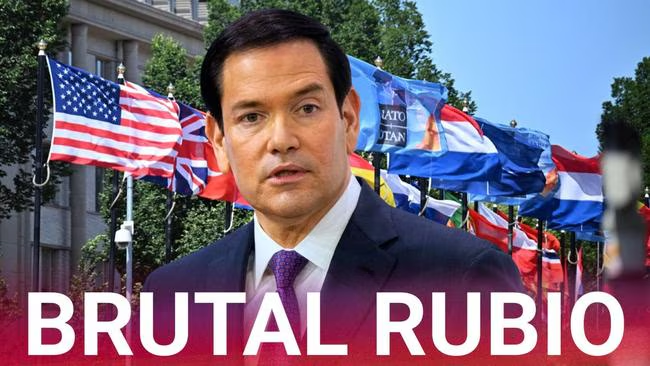
Marco Rubio’s recent statement has caused a stir in the NATO alliance. Under the Marco Rubio NATO warning, he has made it clear that if countries like Spain do not support the US in military operations, NATO’s role may be reconsidered in the future.
The dispute began when Spain refused to use its airspace and military bases (Rota, Morón) in the ongoing U.S. campaign against Iran.
Spanish Defense Minister Margarita Robles called the operation “illegal and unjust”, while Prime Minister Pedro Sánchez called it “dangerous” and “illegal”. This is a clear indication that even within Europe, unanimous support for US military strategy is now weakening.
Now the question is, is NATO really on the verge of breaking up? According to Experts , NATO has been a strong military alliance since 1949, whose main purpose is collective security—meaning if one member is attacked, then all the other countries help.
But recent events have made it clear that each country has its own national interests paramount. Even Lindsey Graham has spoken of sanctions against Spain, a clear sign of US anger. Rubio’s statement—“If there was no US, there was no NATO”—highlights that the US considers itself the backbone of this alliance.
If you look at history, NATO has faced internal disagreements many times, like France and Germany standing against the US during the Iraq War.
The situation today seems to be somewhat similar, with some European countries distancing themselves from the unilateral military actions of the United States.
International law is also being cited behind Spain’s refusal, as military action without UN approval is being questioned. This argument is considered quite strong under global diplomatic norms.
There is also the strategic angle of the Marco Rubio NATO warning. Some analysts believe the statement could be a pressure tactic—to get NATO countries to align with US policy.
The United States does the most defense spending in NATO each year—up to about 70%—because it expects other countries to show equal commitment. But the ground reality is that European countries are now insisting on independent foreign policy, especially when the conflict is in a sensitive region like the Middle East.
This whole affair shows a new phase of global geopolitics—where alliances are no longer fixed on blind loyalty, but on strategic convenience.
If countries like Spain can openly protest, then other countries can change their stance in the future. The future of NATO will now depend on how the US and Europe maintain a balance of mutual trust and mutual benefit.