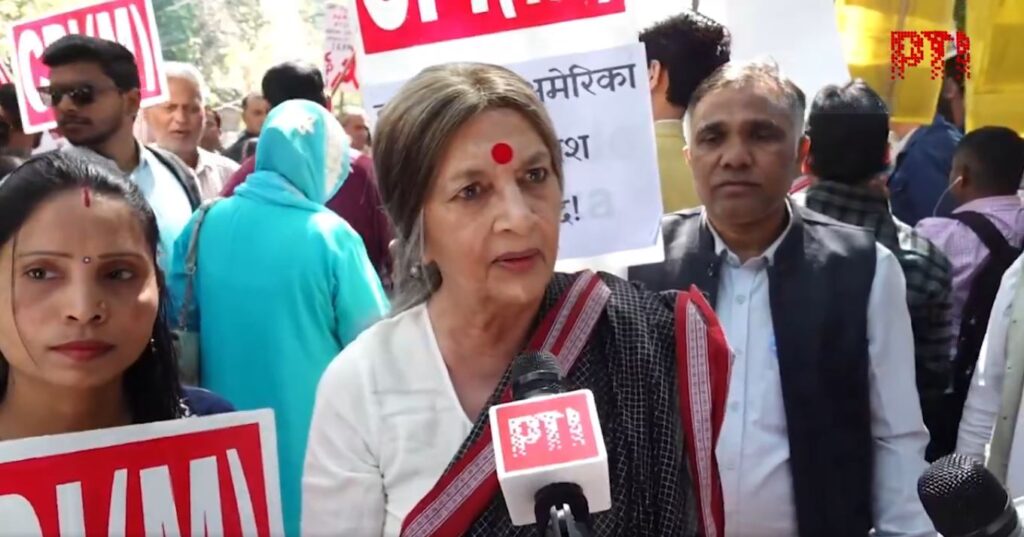
During a recent political demonstration in Dilli, CPI(M) leader Karat Protests Modi lashed out at the Modi government. He alleged that Prime Minister Narendra Modi’s visit to Israel and his embrace of Benjamin Netanyahu there sent a message of support for rising military tensions in West Asia. According to Karat, when news of the death of Iran’s Supreme Leader Ayatollah Ali Khamenei in US action came out, India needed to take a balanced diplomatic stance, not show closeness to any one side.
During the demonstration, Karat Protests Modi said former US President Donald Trump’s policies were a precedent of “imperialist meddling”, which affected the entire region. “Israeli military action in Gaza and the situation we are seeing against Iran are increasing instability around the world,” the protesters said. They argued that India had always been a country that followed the principles of non-alignment and peaceful coexistence, so it was not right to create an image of open support in these circumstances.
On the other hand, the official statement of the Government of India appealed for restraint. The government made it clear that India’s priority is the safety of Indian nationals living abroad, especially in areas where tensions are at their peak. According to the External Affairs Ministry, India is monitoring the situation at diplomatic level and supports dialogue for regional stability.
The issue also intensified debate on social media and in political circles. Many dismiss the Karat and CPI(M) statements as irrelevant, saying the country’s economic interests, especially rising crude oil prices, are more serious concerns. The escalation of conflict in the Middle East has a direct impact on an oil-importing country like India. Pressure on petrol and diesel prices, inflation and trade balance could increase.
Taken as a whole, these issues are not merely ideological conflicts, but complex questions related to foreign policy, energy security and global diplomacy. It is clear from Karat’s performance that differing opinions on West Asia policy exist within the country as well. What remains to be seen is how India balances its national interests and international image in the coming days.