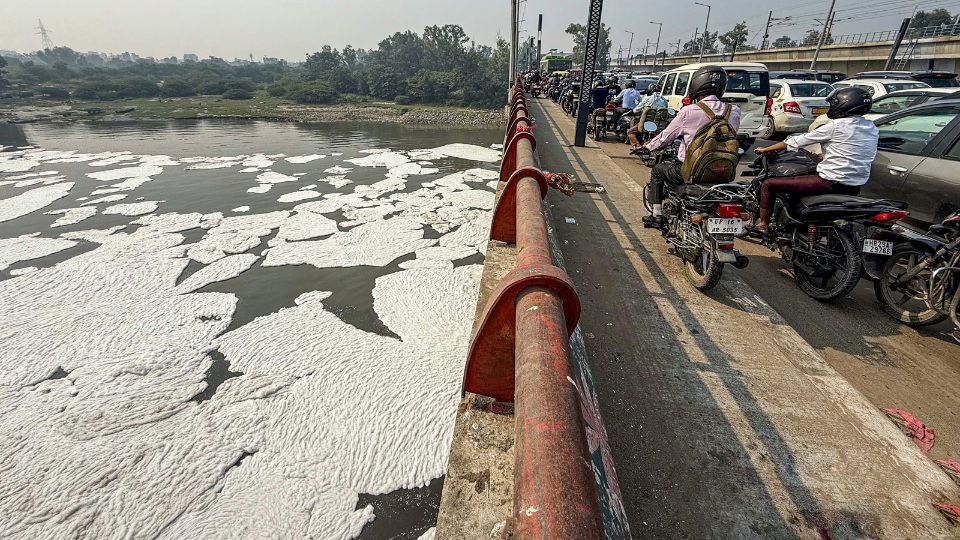
The Delhi Yamuna Turns Toxic Again is covered in poisonous white foam. The scene at Kalindi Kunj Ghat shows that there is a big difference between the government’s claims and the reality on the ground. A layer of thick foam has frozen over the river, making the water invisible.
Data from the Pollution Control Department shows that the BOD level in the Yamuna was 14 to 25 mg/L in November–December 2025, while it should be less than 3 mg/L for bathing water. Even more frightening, fecal coliforms were found at up to 92,000 MPN per 100 ml, a direct attack on human health.
Environmental experts say that in the cold, the flow of water in the Delhi Yamuna Turns Toxic Again decreases. In this condition, untreated sewage and factory wastewater from Delhi’s 22 big canals falls directly into the river.
Phosphates in detergents and chemicals make it a toxic foam. Despite having 37 sewage treatment plants in Delhi, about 80 per cent of the pollution comes from these drains.
Environmental organizations allege that defoaming machines are run every year just to show off during Chhath Puja and elections. The foam goes away in a few days, but the real problem remains the same.
Increasing the capacity of the sewage treatment plant, thorough treatment of the drains and strict action on the factory are still limited to paper.
Advertisement
OnePlus Nord Buds 3R TWS with 54H playback, 3D spatial audio, AI clear calls, dual device pairing & 47ms low latency.
Politics on the issue has also intensified. People are saying that the river is only remembered during elections. After coming to power, neither the Yamuna survives nor the air improves. The Yamuna today is not only a polluted river, but also a testament to the failure of the system.
If concrete steps are not taken, the Yamuna will no longer be a river, it will become a dirty canal. What is needed now is to abandon showy measures and adopt permanent, scientific and honest policies, so that future generations can see Yamuna as a living river, not in a heap of toxic foam.