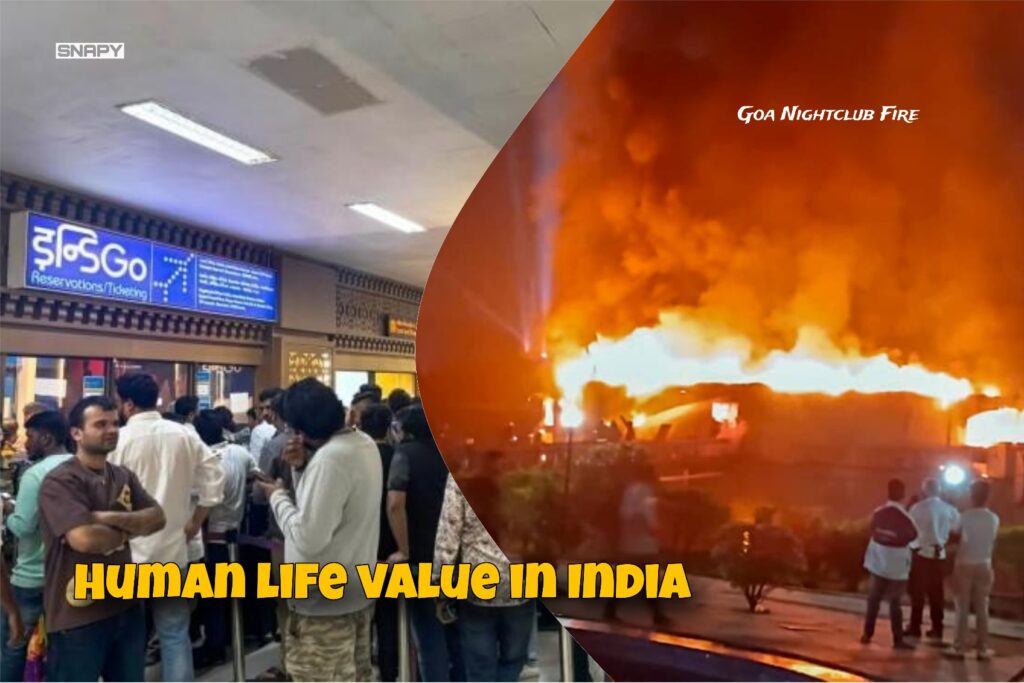
Human life value in India deadly fire at the Indigo and Nightclub in Goa, a case of violence, is a sad reality of India even after 75+ years of independence.
- No regard for the lives of other people.
- No procedures or laws are followed or enforced. Even if they are, bribes are paid to get away with it.
- Money is the only motive. Greed trumps moral values.
The owners will get away with it. The investigation committee will give whatever reasons the owners want.
People will forget. The media will forget.
In the same way, another club or another business will open somewhere else.
Another human life has no value.
In India, profit and self-interest have become so dominant that the safety of human life has become secondary. The Goa nightclub fire and the Indigo incident are examples of how negligence, disregard for safety standards, and a lack of resources lead to the loss of innocent lives.
Human life value in India problem is not just the absence of rules, but the absence of human sensitivity in society and the system.
Lack of interest in following or enforcing rules and regulations.
In India, there is often a deep gap between lawmaking and enforcement.
- Neglect of procedures: Building codes, fire safety, emergency exits, licensing—these have all become mere formalities.
- Cycle of bribery: Even if caught breaking rules, bribery is commonplace. This makes the law a rubber stamp for the rich and powerful.
- Lack of accountability: The system is so complex and corrupt that it is difficult for the common man to access justice.
Money is the only goal, greed has trumped morality.
This reflects a distorted form of capitalism, where maximizing profits has become the sole objective.
- Shortcuts and risks: Instead of investing in safety, priority is given to low costs and quick profits.
- Moral decline: Honesty and principles are considered “naiveté” in society. The only measure of success is money.
The bosses will escape, the investigation committee will deliver the result they desire.
This reflects a crisis of trust.
- Protection of the powerful: Wealthy and influential people escape by using political connections, money, and legal complexities.
- Credibility of investigations: Investigation commissions often work under pressure or submit reports so late that cases go cold.
- Distrust in the justice system: The general public has lost faith in the judicial and administrative systems.
People will forget, the media will forget.
This demonstrates the weakness of collective memory and social awareness.
- 24×7 news cycle: The media covers an incident for only a few days, then moves on to the next “sensation.”
- Public helplessness: The common man is so busy with his daily problems and struggles that he is unable to press any single issue for long.
- Culture of forgetfulness: We condemn the incident but do not try to change the system.
The same method will be adopted elsewhere and a new business will be started.
This points to the recurrence of the problem.
- · Lessons are not learned: Because accountability is lacking and there is no fear of punishment, the same trend resurfaces in a different form, in another place.
- · Superficial solutions: After an incident, there is an immediate response (such as temporary closures, warnings), but fundamental reforms (strict enforcement of the law, moral education, institutional reforms) do not occur.
In short:
Human life value in India it is filled with despair, anger, and frustration, the sentiments of citizens of a country that has repeatedly suffered the emptiness of the system and moral decay.
The author believes that even after 75 years of independence, we have not been able to build a safe, just, and humane society, where dignity of life and the rule of law are paramount.